
Eating Out on Ozempic: How to Find a Meal’s Protein
Ask for the restaurant’s written nutrition information and match protein grams to the named item or ingredient portions. Covered U.S. chains must make protein information available on request.
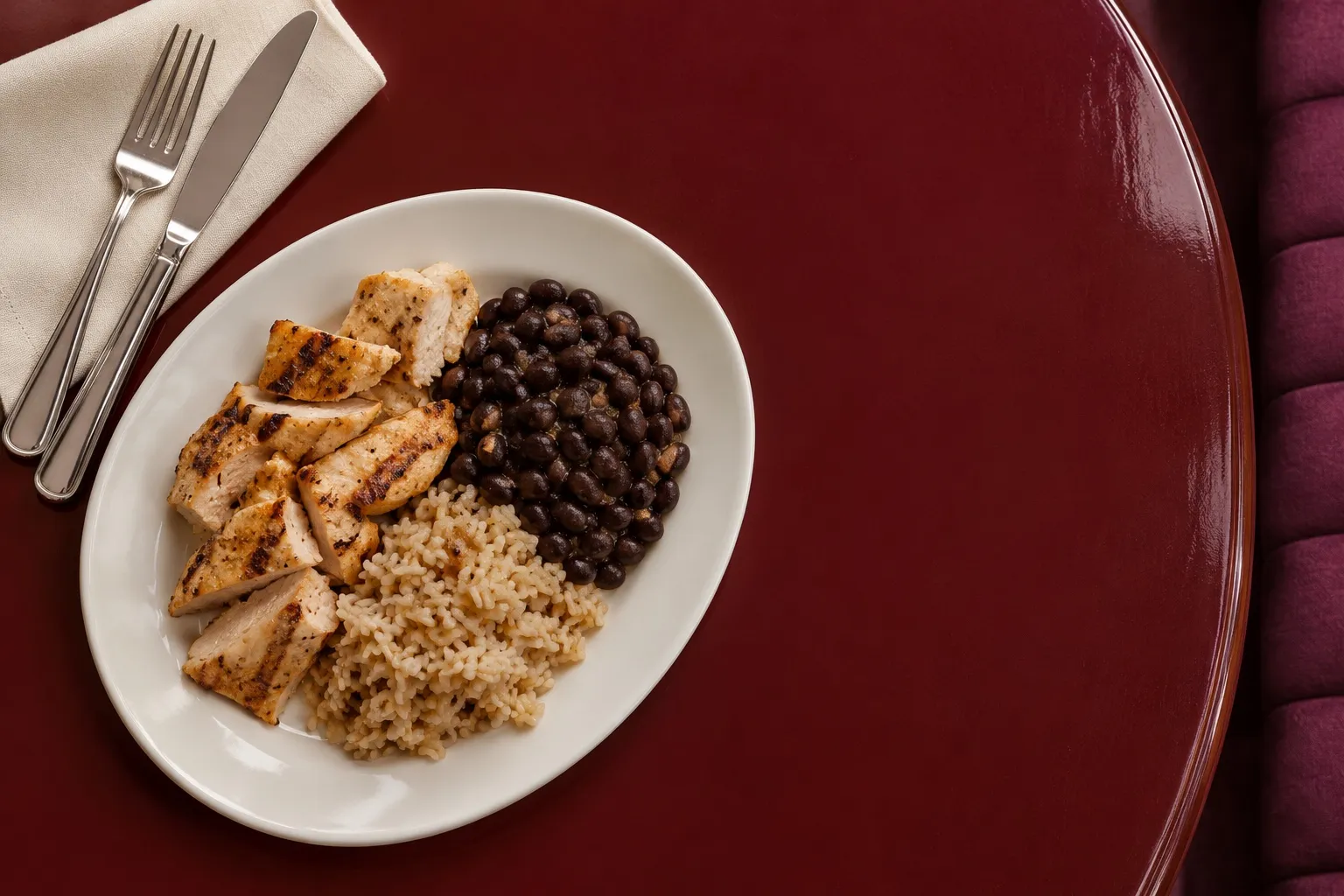
Eating out on Ozempic and looking for a meal’s protein? A menu showing calories but no protein grams is not necessarily missing the information altogether. At covered U.S. chain restaurants, calories belong on menus, while protein is part of the written nutrition information available on request (FDA menu-labeling requirements).
Ask for that written information, then match the protein entry to the exact menu item and listed portion. For a customized meal, add the figures for its included ingredients. The result is listed protein, not a laboratory measurement of your order: Chipotle’s official chart, for example, says serving sizes are approximate and nutritional content varies with portions and recipes (Chipotle nutrition chart).
Where is protein listed if the menu shows only calories?
The written nutrition information is the place to look. FDA’s federal requirements cover chains with 20 or more locations operating under the same name and offering substantially the same menu items. Those establishments must provide protein information for standard menu items on request, alongside nutrients such as fat, carbohydrates and sodium (FDA).
A specific question at the counter is: “Could I see the written nutrition information, including protein, for this item?” The distinction matters. FDA requires calories on menus and menu boards; it does not require protein grams beside every menu price or require that every restaurant publish them online (FDA).
An item name alone is not enough to match a figure. Chipotle’s separate menu page lists a chicken High Protein Cup at 32 g protein and a Double High Protein Bowl at 81 g. The latter names double chicken, light white rice, black beans, fajita vegetables, tomato salsa, cheese and extra lettuce. Its 81 g declaration belongs to that named combination, not any bowl containing chicken (Chipotle’s listed meal configurations).
How do you total protein for a customized restaurant meal?
Add the matching ingredient entries, including their listed portions. In Chipotle’s standard-menu chart, chicken supplies 32 g protein per 4 oz, black beans 8 g per 4 oz, and cilantro-lime brown rice 4 g per 4 oz. These are three separate rows, each with its own portion size (Chipotle nutrition chart).
For those three listed portions, the arithmetic is 32 + 8 + 4 = 44 g listed protein. That is an illustrative ingredient subtotal, not an intake target, portion suggestion or measured amount eaten. It also is not a total for a customized bowl with additional ingredients; the calculation includes only those three chart entries (source figures).
Counting only the meat would omit the beans’ and rice’s contributions. Other entries matter when included, too: the same chart lists 8 g protein for one burrito tortilla and 6 g for a 1-oz cheese portion. An ingredient subtotal and a published whole-item total are different ways of describing an order; adding the included ingredients again to a whole-item total would count them twice (Chipotle nutrition chart).
How close is listed protein to the food on your plate?
The chart describes a listed portion, not an individually tested plate. Chipotle states that serving sizes are approximations and can vary from order to order; it also names recipe differences, growing seasons and ingredient sources as reasons nutritional content can vary. A 4-oz entry therefore does not establish the weight of a particular scoop (Chipotle nutrition chart).
Restaurant research does not supply a protein error percentage here. In a 2011 JAMA study, researchers measured energy in 269 food items from 42 restaurants, sampled in Massachusetts, Arkansas and Indiana in 2010. Stated calories were accurate overall, with substantial discrepancies for some individual foods. The endpoint was energy measured by bomb calorimetry, not protein grams; its results cannot turn the illustrative 44 g subtotal into a protein uncertainty range (Urban et al.).
What belongs in a restaurant meal log?
For the worked example, a note could read: “Chicken, black beans and brown rice; 44 g listed protein for the chart’s three 4-oz portions.” The ingredient names, portions and source explain what the number represents. “44 g measured protein” would describe evidence the chart does not provide (Chipotle nutrition chart). Our dated meal and appetite records article covers the wider record-keeping question.
Leftovers introduce a different question: how much of each ingredient was eaten? Dividing the 44 g subtotal by two gives 22 g arithmetically, but that calculation assumes half of each listed ingredient. It is not a measurement of half a mixed bowl. Keeping the published amount separate from an estimated amount eaten preserves that distinction; what GLP-1 protein studies actually measure explains related differences between recorded intake and study measurements.
FAQ
Do independent restaurants have to provide protein information?
The federal rule described here covers chains meeting the 20-location, same-name and substantially-same-menu conditions. It is not a requirement for every U.S. restaurant, so that rule alone does not establish that an independent restaurant must supply protein grams (FDA).
Do GLP-1 restaurant tips change how protein is counted?
The cited restaurant chart gives protein per listed portion, not a separate value for GLP-1 diners. The example remains 32 + 8 + 4 g for those three entries; it does not establish how much someone taking Ozempic should eat (Chipotle nutrition chart).
Does chicken’s protein entry cover the whole meal?
No. In the worked example, chicken’s listed 32 g covers its 4-oz portion. Beans and brown rice have separate protein entries; a tortilla or cheese adds another entry when included (Chipotle nutrition chart).
References
- U.S. Food and Drug Administration. Menu Labeling Requirements. FDA
- Chipotle Mexican Grill. US Nutrition Facts Paper Menu, standard-menu table and portion-variation notes. Official posted chart
- Chipotle Mexican Grill. Chipotle High Protein Menu. Listed meal configurations; accessed November 9, 2026. Official menu page
- Urban LE et al. Accuracy of Stated Energy Contents of Restaurant Foods. JAMA. 2011. doi:10.1001/jama.2011.993. Original study